Will County Animal Protection Services Seeks New Facility Amid “Gaping Wound” of Space Crisis
Article Summary:
Will County Animal Protection Services is seeking approval for a new facility, telling a county committee that its current building is critically inadequate for housing animals, leading to severe operational challenges and the suspension of its public adoption program. Administrator Anna Payton described the situation as a “gaping wound” that stop-gap measures can no longer fix.
Will County Public Health & Safety Committee Key Points:
-
The department’s current building, not designed to house animals, dedicates only 3% of its footprint (225 square feet) to animal holding, causing major plumbing, HVAC, and sewer problems.
-
Due to severe overcrowding, the department has suspended its public adoption program, is housing animals off-site, and cannot expand services to other municipalities.
-
The department is self-funded primarily through rabies tag registrations and is asking for county board approval to spend its own money on a new capital project, not for a general fund allocation.
JOLIET, IL – Will County Animal Protection Services is facing a severe space crisis in a facility that was never designed to house animals, forcing the department to suspend its public adoption program and turn away municipalities seeking its services.
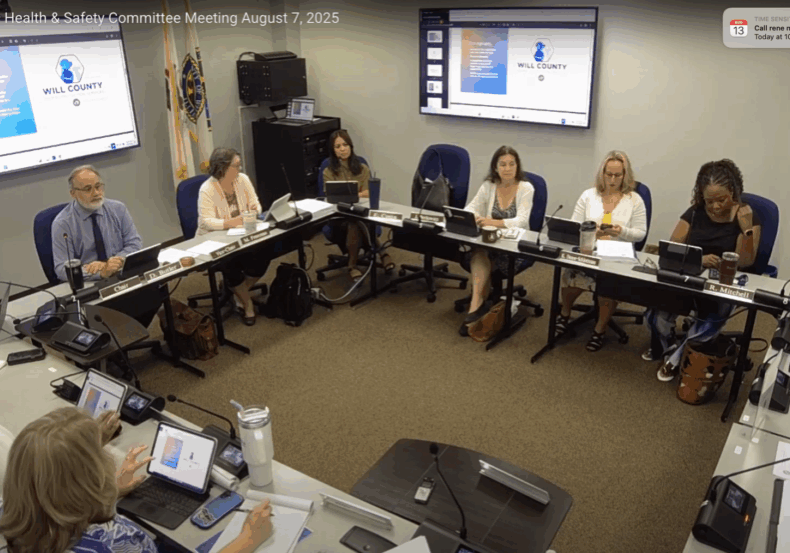
During a presentation to the Will County Board Public Health & Safety Committee on Thursday, Animal Protection Services Administrator Anna Payton detailed a litany of problems stemming from their building’s inadequacy, calling it a “gaping wound” that requires more than a Band-Aid solution.
“Our building was not built to house animals. I can’t emphasize that enough,” Payton said. “Three percent of the footprint of our building was built to house animals. That is 225 square feet out of a 6,700-foot building.”
Payton explained that the building, constructed before the department began housing animals on-site post-COVID, has only five small kennels intended for short-term, post-operative recovery, not for seven-day stray holds. With the department taking in 870 domestic animals in 2024—including dogs, cats, rabbits, chickens, and guinea pigs—the space is completely insufficient.
Efforts to retrofit two garages with kennels have provided temporary relief but have led to significant infrastructure failures, including HVAC issues and sewer problems that are not designed to handle animal waste. Payton noted one estimate to fix the plumbing alone was $55,000.
“It’s just not sustainable and it’s not built to house what we need,” she said.
The chronic overcrowding has had significant consequences. Payton announced that the department has temporarily suspended its adoption program, which just began in 2024, and is now contracting with an organization in Naperville to house its animals off-site. Furthermore, the lack of space prevents the department from entering into intergovernmental agreements with other municipalities that need animal control services.
The location itself presents challenges, as the building is situated next to the sheriff department’s gun range. “The guns going off is not only frightening to the animals, but it’s unsettling to the people that come in,” Payton said, adding it undermines the welcoming environment needed for adoptions and public engagement.
The issue was highlighted by a recent cruelty case where the department had to house 13 chickens as evidence. “We’re having those in our third garage bay. So, we’re operating over capacity, inappropriate housing for those animals,” she said.
Despite the challenges, Payton highlighted numerous successes, including a rebranding from “Animal Control,” updated ordinances, and partnerships with Joliet Junior Community College and Wilco for student training. The department also runs the “Whiskers at Work” program, which places feral cats as working mousers on farms, and has provided free microchips to nearly 400 pets in two years.
Payton is asking the county board for budget approval to pursue a new facility. As a self-sufficient department funded by rabies tag registrations and not taxpayer dollars from the general fund, it needs the board’s authorization to spend its own money on a major capital project.
Committee Chair Daniel J. Butler (R-Frankfort) and other members appeared supportive. “I get a pretty good idea that pretty much people are in favor of that,” Butler said. He asked Payton to return next month with a formal proposal to be submitted for the county’s capital budget.
Payton suggested an ideal location would be centralized, in a nicer area that feels like a “community destination,” and has adequate space for volunteers, educational programs, and proper housing for various species, including livestock.





Isolated Rain Showers
Latest News Stories
U.S. Senate passes landmark bipartisan housing bill, sends to House

POLL: Majority of voters believe U.S. should stay in NATO

Nonprofits: Los Angeles schools need to do better following Carvalho’s resignation

Chicago anti-violence department proposed; activist dismisses Trump post

Pritzker plans to sign social media law despite criticisms

Illinois Quick Hits: IDOT says all 102 counties to have transit
Poll: Taxes, economy top voter concerns

Murphy, Dhillon go to bat for players in baseball’s Pride Night black eye

Republicans compete to face Neguse in congressional race

Vance says ‘progress’ made in talks with Iran
Report: Eight Michigan counties among most vulnerable to Social Security cuts

Los Angeles schools superintendent resigns after FBI probe