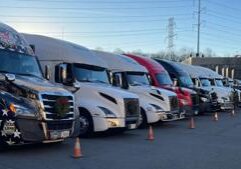
Feds sue California over emission standards for trucks
The U.S. Department of Justice is suing California to stop what it calls “unlawful” emission standards for heavy-duty trucks.
The California Air Resources Board is continuing to enforce “stringent emission standards” for trucks despite President Donald Trump’s congressional resolutions in June invalidating the Environmental Protection Agency’s preemption waivers for the state’s two standards on emissions for trucks.
Therefore, the Department of Justice filed a complaint against the California Air Resources Board in the Northern District of Illinois on Wednesday as well as in the Eastern District of California on Thursday.
The complaints were filed with motions to intervene and join previous plaintiffs in litigation against California in the two courts.
The Department of Justice’s Environment and Natural Resources Division claims the Clean Air Act prohibits the California Air Resources Board from enforcing regulations granted under the EPA’s waivers. That is because the Clean Air Act prevents states from enforcing regulations on vehicle emissions unless the EPA grants the state a preemption waiver.
The division also said Trump’s decision in June was part of his commitment to “end the electric vehicle mandate, level the regulatory playing field and promote consumer choice in motor vehicles.”
“Agreement, contract, partnership, mandate — whatever California wants to call it, this unlawful action attempts to undermine federal law,” Acting Assistant Attorney General Adam Gustafson of the DOJ’s Environment and Natural Resources Division said in a press release Friday. “President Donald Trump and Congress have invalidated the Clean Air Act waivers that were the basis for California’s actions. The California Air Resources Board must respect the democratic process and stop enforcing unlawful standards.”
The California Air Resources Board is trying to find a way around its prohibition by enforcing the emission standards through the Clean Truck Partnership.
The complaint in the Eastern District of California was filed by four truck manufacturers: Daimler Truck North America, Paccar Inc., International Motors and Volvo Group North America.
International Motors said in a press release Monday, original equipment manufacturers — companies that sell parts to other companies that need them to build their products – are being asked to meet “conflicting mandates,” which in turn is affecting International Motors’ ability to produce and deliver vehicles to its customers.
“We are asking the courts for a swift resolution so we can continue providing the dependable solutions our customers count on every day, including the S13 Integrated Powertrain, which offers a fuel economy-leading powertrain option capable of achieving low NOx,” International Motors said.
The complaint in the Northern District of Illinois was filed by the American Free Enterprise Chamber of Commerce.
“Electric vehicles are more expensive, unfeasible and threaten the automotive industry, workers, and the millions of ordinary Americans who depend on cars and trucks with internal combustion engines every day,” Gentry Collins, CEO of American Free Enterprise Chamber of Commerce, said in a press release Aug. 4. “Just because Governor Newsom doesn’t like the outcome doesn’t mean he can weaponize the courts to subvert the will of elected representatives who answer to voters.”
Latest News Stories

Assaults against ICE up 1,153% in 11 months

Illinois quick hits: Deer harvest totals; IHSA voting begins

Texas officials seek to establish Turning Point chapters
Peotone School District Honors Nearly 90 Students for High Achievement on State Exams

National Guard member shot near White House dies

New Bar Approved in Frankfort Despite Board Opposition

Chicago tenant groups call for eviction moratorium amid ICE raids

Illinois tax proposals dampen decline in small business uncertainty index

JJC Board Approves Grundy County Land Purchase Amid Heated Debate

‘Trouble in Toyland’ report sounds alarm on AI toys
Support Staff Urge Lincoln-Way 210 Board for ‘Fair Contract’ During Public Comment

When was the first Thanksgiving? It’s actually up for debate