What a terrorist designation could mean for Antifa
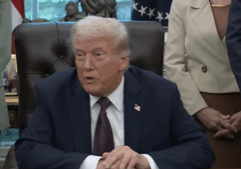
President Donald Trump declared Antifa a terrorist organization on Wednesday, describing them as a “sick, dangerous, radical left disaster;” however, it’s unclear at this time if or how the president will make the designation official, and what it all means for the group.
The Anti-Defamation League, a group that fights “all forms of antisemitism and bias,” defines Antifa as a “decentralized, leaderless movement composed of loose collections of groups, networks and individuals.”
Awareness of the movement, whose name stands for “anti-fascist,” spread in 2020, when its members were active in Black Lives Matter protests, riots, looting and clashes with police.
Domestic terrorism is defined in federal law as criminal acts occurring in the U.S. that either threaten human life, are intended to coerce or intimidate civilians or to influence government policy or action. But, domestic terrorism on its own is not a criminally chargeable offense.
Congress has considered the possibility of new domestic terrorism laws, but concerns over constitutional rights have seemingly prevented lawmakers from doing so.
“Any congressional consideration of additional legislation in the area of domestic terrorism—such as a criminal statute expressly prohibiting acts of domestic terror—would necessarily involve a broader discussion of potential policy concerns and constitutional constraints,” reads a report by the Congressional Research Service.
“Legislation seeking to address domestic terrorism also may implicate certain constitutional considerations, such as First Amendment protections of speech and association, Fourth Amendment restrictions on government searches, and broader federalism-based restraints on federal jurisdiction in general,” the authors added.
In his Wednesday post on Truth Social, in addition to the terrorist designation, Trump implied that any groups financially supporting Antifa could expect federal scrutiny.
“I will also be strongly recommending that those funding ANTIFA be thoroughly investigated in accordance with the highest legal standards and practices,” he wrote.
In a response to a question from The Center Square regarding Antifa, the president mentioned going after the group through the Racketeer Influenced and Corrupt Organizations Act, or RICO, a federal statute that was critical to the FBI’s takedown of the American mafia. It allowed prosecutors to hold mob bosses and other leaders accountable for crimes they directed lower-level members to commit.
“I’ve asked Pam [Bondi] to look into that in terms of bringing RICO cases… criminal RICO,” Trump said, “because what they’re doing to this country is really subversive.”
However, many have noted that it may be difficult to do since RICO was created for organized crime, and Antifa is allegedly leaderless.

Mostly Sunny
Latest News Stories
Trump gives boost to Lebanese relations; puts squeeze on Iran in the process
Illinois news in brief: State police use grant money to recover 342 stolen vehicles; State launches Blue Envelope program; Treasurer: State returned $307.8 million in I-CASH
Biden recordings case could head to U.S. Supreme Court

Pritzker touts climate, green energy record as capacity leaves, rates rise
Warren will campaign this weekend for El-Sayed in Michigan

Trump hits Canada with new tariffs Congress may be powerless to stop
Abbott directs healthcare, regulatory agencies to target birth tourism in Texas
Fugitive accused in $547 million Medicare fraud scheme captured

Ongoing border enforcement: Revocation of citizenship of convicted criminals
Minnesota wildfires prompt burning restrictions as air quality improves
Poll: Americans views of socialism little changed despite recent elections
Malliotakis: Commie Caucus is coming to Congress