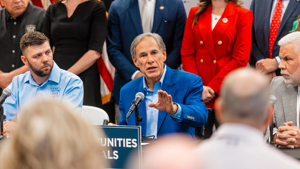
Record-long govt shutdown threatens food, early childhood education assistance
Senate Democrats are set to block Republicans’ government funding bill for the 12th time Wednesday, keeping the federal government shut down despite tens of millions of low-income Americans at risk of losing food stamps or early childhood education assistance.
Although the U.S. Department of Agriculture will resume core Farm Service Agency financial services Thursday, the unfunded agency cannot provide money to support SNAP or WIC benefits for the month of November, which together serve up to 49 million people.
Phil Fisher, director of Stanford’s RAPID Survey Project that tracks American children’s access to basic needs, says the shutdown is impacting American families already struggling with food security.
“The government shutdown comes at a time when families with young children are already under extraordinary strain. Our latest data from the RAPID Survey Project show that nearly half of families with children under age six are struggling to afford basic needs like food, housing, and utilities,” Fisher told The Center Square.
“Programs like WIC and other nutrition supports are critical lifelines for children’s health and development,” he added. “When those programs are disrupted, even temporarily, the effects on families can be immediate and lasting.”
The Department of Health and Human Services’ Head Start program – which offers early education, food assistance, and other support to low-income families – is also struggling. The National Head Start Association recently warned that some local programs are barely scraping by on emergency resources.
“[S]ix Head Start programs serving 6,525 children are already operating without federal funding, drawing on emergency local resources to stay open,” NHSA said in a news release. “By November 1, 2025, another 134 programs across 41 states and Puerto Rico, serving 58,627 children, will face the same cliff unless Congress and the president act swiftly.”
The federal government has remained shuttered for more than three weeks after running out of funds Oct. 1.
Congress was supposed to pass all 12 annual appropriations bills funding federal agencies for fiscal year 2026 by Sept. 30.
Realizing lawmakers couldn’t finalize all the bills in time to meet the government shutdown deadline, House Republicans passed a clean Continuing Resolution to keep government funding on cruise control until Nov. 21, buying Congress more time.
Senate Democrats blocked the CR, however, demanding that any funding stopgap also codify the temporary expansion of the Obamacare Premium Tax Credit into law. They are set to expire at the end of the year. Republicans refused, and as a result, the federal government ran out of funding and shut down.
Negotiations have proven fruitless since then. Republicans say Democrats’ demands are “unreasonable.” Democrats counter that if the subsidies are not extended, tens of millions of Americans could see their health care premiums rise.
“The Republican leader’s plan is to do nothing while those prices get locked down and people get priced out of their health care,” U.S. Sen. Patty Murray, D-Wash., told lawmakers Tuesday. “Don’t tell us to wait…‘Wait’ is not a solution.”
Permanently extending the enhanced version of the PTC – which was only meant to last through the COVID-19 pandemic and is scheduled to expire Dec. 31 – would cost an estimated $349.8 billion over the next decade alone, according to the Congressional Budget Office.
Even if Republicans and Democrats miraculously came to an agreement on the CR Thursday, the bill’s originally seven-week long funding extension no longer applies, given that lawmakers have already wasted a large chunk of that time period.
Senate Majority Leader John Thune, R-S.D., has hinted that the House may need to return to redraft and extend the CR’s timeframe, a scenario that no Republican finds ideal.
This article was edited post-publication to clarify that neither Dr. Phil Fisher nor Stanford University is advocating for or against any congressional activity.






Mostly Sunny
Latest News Stories

Grijalva, Butierez headed for rematch in congressional race

Biggs wins Arizona gubernatorial primary with 71.5% of vote

Trump endorsements score wins for Arizona candidates

Republicans advance bill to make Trump border policy permanent

Trump admin investigates five medical schools over DEI

Lawyer: Billionaire tax could cost California $1 trillion

Hegseth defends Trump’s request for $67B to fund Iran conflict

Official: Agreement could come soon on Colorado River
Trump gives boost to Lebanese relations; puts squeeze on Iran in the process

Illinois news in brief: State police use grant money to recover 342 stolen vehicles; State launches Blue Envelope program; Treasurer: State returned $307.8 million in I-CASH

Biden recordings case could head to U.S. Supreme Court

Pritzker touts climate, green energy record as capacity leaves, rates rise