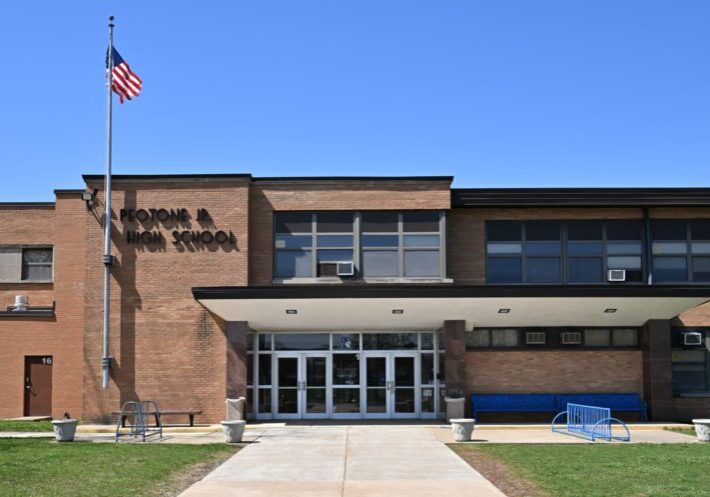
Residents Clash on School Funding, Citing Low Tax Rate vs. “Wasteful” Spending at Committee Meeting
Peotone School Board Committee of the Whole Meeting | October 27, 2025
Article Summary
The Peotone School Board heard conflicting public perspectives on its long-standing financial crisis, with one resident presenting detailed data showing the district has the lowest tax rate in the area despite a high tax base. Another resident, however, argued that district overspending is the core issue and that a failed tax referendum would not have solved the current multi-million-dollar deficit.
Peotone School Funding Debate Key Points:
-
Resident Nick Chapman presented data showing Peotone’s tax rate (3.64%) is the lowest among six neighboring school districts.
-
The compared districts were Crete-Monee, Beecher, Grant Park, Manteno, and Wilmington.
-
Despite a strong local tax base, Peotone’s total revenue per student is among the lowest of its peers due to a lack of state and federal aid.
-
Resident John Maxedon argued that if the last tax referendum for $2.4 million had passed, the district would still be overspending by millions.
PEOTONE, Il. – A deep divide in public opinion over the cause of Peotone School District’s financial woes was on full display as residents addressed the Board of Education with detailed data and sharp criticism on October 27.
Resident Nick Chapman presented a comprehensive financial comparison between Peotone and five neighboring school districts—Crete-Monee, Beecher, Grant Park, Manteno, and Wilmington—arguing that the community is not funding its schools adequately. According to his data, sourced from the Illinois State Report Card, Peotone has the highest median household income ($106,000) and the lowest tax rate (3.64%) in the area.
Chapman pointed out a “paradox” in the district’s finances: while Peotone has an exceptionally high property value per pupil ($370,000), this wealth disqualifies it from significant state and federal aid, leaving its total revenue per student among the lowest of its peers.
“Maybe, just maybe, this chart shows a picture of a district whose revenue is misaligned with its needs,” Chapman said, referencing a historical chart of district deficits. “The simple fact of the matter is that our students are not being resourced as well as our neighbors.”
However, resident John Maxedon, who is a candidate for a vacant board seat, argued the problem lies not with revenue but with spending. He noted that the last failed tax referendum sought $2.4 million, yet the district’s current deficit is projected at $4 million.
“Which tells me that if the district had gotten what it asked for, we would still be overspending by double of what you asked for,” Maxedon said. “I hate waste… if the district continues to operate in a way where you attempt to raise a referendum for 2.4 million and then overspend by 4.8, I also pledge to you to continue being a bump in the road.”
Chapman highlighted that the last successful referendum in 2006 was not to increase operating funds, but to raise the district’s debt limit, “officially endorsing this policy of working cash bonds that everyone is now arguing against.”






Partly Sunny
Latest News Stories
U.S. population growth slows after Trump border policies enacted

Maryland joins mid-decade redistricting fight

Democrats call for Noem’s removal after second fatal shooting by DHS agent

Illinois cannabis industry cautious on child-safety bill, questions focus on regulated products

87 indicted in TdA, Colombian, Venezuelan ATM jackpotting scheme in Nebraska

States, caregivers can now view key metrics for state child welfare systems

More Illinois Catholic schools close; candidates call for change

U.S. effort to limit China’s influence reaches Latin America

Govt. shutdown risk spikes as Senate Democrats vow to tank funding package

Report: EU regulations cost billions for American tech companies

Acting ICE director ordered to court by Minnesota federal judge

Crackdown in Minneapolis underway following Trump talks with Walz, Frey