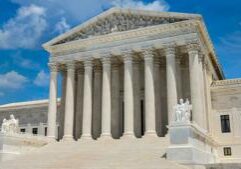
SCOTUS rules on warrantless searches, double convictions and election suits
(The Center Square) – The U.S. Supreme Court decided three cases Wednesday about political candidates’ standing to sue, warrantless searches, and double convictions.
The justices marked Jan. 14 as the first day in 2026 where they released multiple opinions.
Here are summaries of those opinions.
Case v. Montana
In a 9-0 decision, the court upheld the conviction of a Montana man for assaulting a police officer.
In 2021, police officers entered the home of William Case after a credible report that he was threatening suicide. While searching the home, one officer approached a bedroom closet in which Case was hiding.
Case threw open the closet curtain while holding an object that looked like a gun, according to court documents. The officer shot and injured Case.
Case argued the officers violated his Fourth Amendment right by entering his home without a warrant.
In a the majority opinion for the court, Justice Elena Kagan said the officers has reason to believe Case intended to take his own life or may already have shot himself.
“The officers may enter if, and only if, they have an ‘objectively reasonable basis for believing’ that an occupant faces serious danger,” Kagan wrote.
Kagan pointed to several other examples in the Supreme Court’s precedent where the justices upheld warrantless entries.
“We repeat today what we have held before: An officer may enter a home without a warrant if he has ‘an objectively reasonable basis for believing that an occupant is seriously injured or imminently threatened with such injury,'” Kagan wrote.
Barrett v. U.S.
In another opinion, the court clarified procedures for obtaining multiple criminal convictions for an individual act.
The case focused on Dwayne Barnett, an individual who committed a series of robberies between August 2011 and January 2012. In one robbery, Barrett’s accomplice shot and killed Gamar Dafalla, according to court documents.
Prosecutors sought to charge Barrett with two separate convictions: unlawful possession of a gun during a crime of violence and causing death while committing an offense.
In the court’s majority opinion, Justice Ketanji Brown Jackson said Congress does not allow an individual to be dually punished for the separate crimes when it stems from a single action.
“At the very least, Congress did not clearly manifest a contrary intention, as it would have to do if it wished to authorize two convictions in these circumstances,” Jackson wrote.
Bost v. Illinois State Board of Elections
In a 7-2 decision, justices on the court said an Illinois congressman has the right to sue the state over counting federal election ballots beyond Election Day.
U.S. Rep. Mike Bost, R-Murphysboro, filed a lawsuit against the state in 2022 for counting ballots postmarked on Election Day up to two weeks later. The court affirmed Bost had legal standing to sue without addressing whether states could allow mail-in ballots received after Election Day to be counted.
Chief Justice John Roberts, in a majority opinion for the court, said individuals who sue must display a personal stake in a case to have standing. As a candidate for office, Roberts said, Bost had that standing.
“Candidates are not common competitors in the economic marketplace. They seek to represent the people,” Roberts wrote. “And their interest in that prize cannot be severed from their interest in the electoral process.”
In their dissent, Justices Sonia Sotomayor and Ketanji Brown Jackson took issue with Roberts’ claim that candidates have a special interest in the fair elections process that gives special standing to sue.
“In a democratic society like ours, the interest in a fair electoral process is common to all members of the voting public,” Jackson wrote. “The Court thus ignores a core constitutional requirement while unnecessarily thrusting the Judiciary into the political arena.”





Sunny
Latest News Stories

Report: Patchwork state food laws could raise grocery prices 12% nationwide
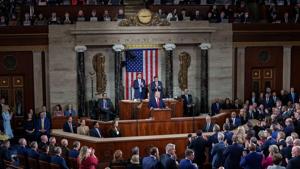
Trump calls out Minnesota in State of the Union, prompting Democrat protests

Parents could gain access to school discipline evidence under proposed bill
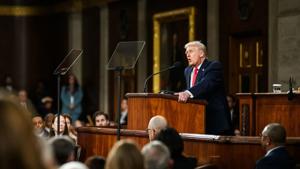
State of the Union highlighted political fracture between Democrats, Trump
Illinois Democrats dispute Trump statements during State of the Union

Illinois Quick Hits: State taxpayers to help restore historic Chicago hotel
Trump moves ahead with tariff plans after Supreme Court ruling

Illinois racial wealth gap among largest in country
Judge: Right to sue under IL biometrics law too important to end suit vs Meta

Executive Committee: Tension Rises as Republican Whip Removed from Panel

Ad-Hoc Committee: County Stripped of Power to Regulate Motor Races, Must Drop Solicitor Fees Due to State Statutes

Commission Overrides Staff Recommendation, Approves Manhattan Township Barn Expansion
Chicago could owe $100M+ in refunds for excessive city tickets