Govt. funding process close to finish line as Senate preps for final vote
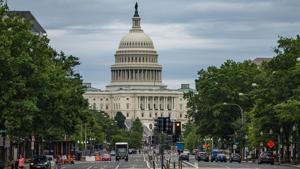
The ball is in the U.S. Senate’s court to avert a government shutdown Jan. 30, with six fiscal year 2026 appropriations bills signed into law and six more having passed the House.
But the Republican-led upper chamber must still contend both with strong Democratic opposition to one of the funding bills and severe winter weather potentially hindering a successful vote.
Because of the winter weather cancelling Monday’s session, senators will vote Tuesday on all six bills in one $1.9 trillion package. The appropriations bills fund State-Foreign Affairs, Financial Services, Defense, Labor-HHS-Education, Transportation-HUD, and Homeland Security.
Given that U.S. Sen. Rand Paul, R-Ky., opposes the package due to fiscal concerns, Republicans need at least eight Democratic votes for the legislation to overcome the filibuster.
Bundling the bills together increases the chances of the legislation succeeding, given that year-long funding for so many sectors of government is on the line. But many Democratic senators are refusing to support it because of the Homeland Security bill.
Even though the bill sets aside $20 million to purchase body cameras for federal immigration officers, Democrats have demanded more guardrails.
“I will not vote for any budget deal that gives more power and funding to Donald Trump so he can make life more dangerous and more expensive for American families,” U.S. Sen. Elizabeth Warren, D-Mass., posted on X Friday. “Congress must restrict spending on forever wars overseas and stop ICE’s terror here at home.”
The debate over whether Immigration and Customs Enforcement agents have overstepped their authority reignited after an ICE agent fatally shot a Minnesota woman, who federal officials say was trying to run over law enforcement officers with her vehicle.
Sens. Cory Booker, D-N.J., Alex Padilla, D-Calif., John Hickenlooper, D-Colo., have also publicly vowed to vote no, while dozens of others have heavily criticized ICE in recent days.
If the package passes and becomes law, Congress will have properly funded the federal government for the first time in nearly two years.
Lawmakers failed to pass a single appropriations bill in fiscal year 2025. They instead resorted to passing four consecutive Continuing Resolutions, keeping funding levels static, rather than complete the regular-order appropriations process.





Partly Sunny
Latest News Stories

Illinois Quick Hits: Fuel price drops below $4.25, still higher than in 2025

U.S.-Iran talks stalled after Israel-Hezbollah fighting

California’s billionaire tax officially heads to Nov. 3 ballot

Los Angeles County on track to raise sales tax to 10.25%

EXCLUSIVE: Individual targeted in foiled UFC terror plot speaks out

Disability-rights advocates sue Illinois over physician-assisted suicide law

Supreme Court backs gun rights for marijuana users in 9-0 decision
Iran deal omits terror proxies, ballistic missiles, human rights

‘No kings’ at $830 million Obama Center opening

Alleged UFC White House ringleader was in US illegally

‘Policy blunder’ or ‘pathway to peace’: Republicans divided over Iran deal

Second produced water treatment pilot facility online in Permian Basin