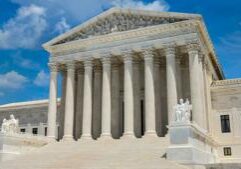
U.S. Supreme Court to define decades-old consumer law
The U.S. Supreme Court agreed on Monday to decide how a 1988 video privacy law applies to the modern age.
Salazar v. Paramount Global seeks to challenge the 1988 Video Privacy Protection Act’s definition of “consumer” in reference to all goods and services or only audiovisual goods and services provided by a video tape service provider.
Michael Salazar subscribed to Paramount’s online newsletter to view videos. According to Salazar’s lawyers, Paramount shared his Facebook ID and video-watching history to Meta.
The primary issue in litigation is how the VPPA defines the term “consumer.” In the legislation drafted by Congress, “consumer” is defined as “a subscriber of goods or services from a video tape service provider.”
The argument lies in whether the statute refers to all goods and services or specifically audiovisual goods or services.
“The VPPA broadly prohibits a video tape service provider—like Paramount here—from knowingly disclosing ‘personally identifiable information concerning any consumer of such provider,’” lawyers for Salazar wrote.
Lawyers for Paramount Global argue that Salazar had access to content on its 247Sports platform, which was available to anyone on the internet.
“All Salazar allegedly did was sign up for a free, written email newsletter. That is not a ‘video cassette tape or similar audio visual material,’ so he is not a ‘consumer’ under the statute,” lawyers for Paramount wrote in a brief to the Supreme Court.
The law originated after a journalist obtained the video rental records of Robert Bork, a nominee to the U.S. Supreme Court. Congress cited privacy concerns as technology evolved and “revolutionized our world.”
In an era of streaming and video rentals, justices on the nation’s highest court will likely provide clarity for consumer privacy protections through this case.






Mostly Cloudy
Latest News Stories

Pritzker says felon was unlucky to land in his back yard

Chicago council approves ballot question to recoup costs from ICE operations

Anti-ICE ‘extremist’ charged with arson in attack outside NYC federal building

World Cup events safe; terrorism, antisemitism concerns don’t materialize

Senators advance healthcare price transparency bill

Sales tax hike to hit Cook, collar counties on Aug. 1
As aggressions continue, Trump warns Iran to ‘pay a big price’

Another Mexico-Canada-US northern border smuggling ring busted
Fetterman tells Congress to hurry up and ‘make weed legal’
Mamdani backs off threat to arrest Netanyahu

Expected Colorado River pact seen as step in right direction
U.S. House passes govt funding stopgap to avoid shutdown