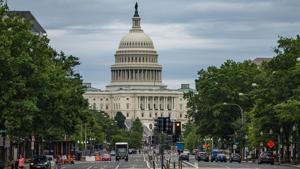
Senate passes funding deal, sends to House for final approval
The U.S. Senate sent a $1.2 trillion government funding package back to the House for approval Friday night, ensuring a partial government shutdown over the weekend.
The package includes five of the six remaining appropriations bills – funding State-Foreign Affairs, Financial Services, Defense, Labor-HHS-Education, and Transportation-HUD – and a short-term Continuing Resolution in place of the Homeland Security bill.
The stopgap will freeze DHS funding at current levels for the next two weeks, during which time lawmakers will restructure the Homeland Security bill to add some Democrats’ policy demands.
“The agreement we reached today did precisely what Democrats wanted,” Senate Minority Leader Chuck Schumer, D-N.Y., told reporters after the vote.
The funding compromise resulted from negotiations among party leaders, as well as President Donald Trump directly negotiating with Schumer.
In exchange for securing enough Democratic votes to advance the majority of the remaining appropriations bills, Republicans agreed to include new restrictions on immigration enforcement agents in the Homeland Security bill.
Those could include barring agents from wearing masks, requiring body-worn cameras, and implementing stricter warrant requirements, among other changes.
Many Republicans in both the House and Senate disapproved of the deal and vowed to vote against legislation that overhauls Immigration and Customs Enforcement.
Chamber leaders had originally considered passing the five appropriations bills separately from the CR and sending them to Trump’s desk immediately, but ended up bundling them together for a greater chance of the funding stopgap passing the House.
Sen. Tommy Tuberville, R-Ala., voted for the package but said he was “disturbed that Republicans are negotiating with Democrats on so-called ‘reforms’ to ICE.”
“In two weeks, I will vote against any ‘reforms’ that keep ICE agents from doing their jobs and deporting criminals,” he added.






Cloudy
Latest News Stories

Poll: Data center opposition more important than competition with China

Illinois Quick Hits: Fuel price drops below $4.25, still higher than in 2025

U.S.-Iran talks stalled after Israel-Hezbollah fighting

California’s billionaire tax officially heads to Nov. 3 ballot

Los Angeles County on track to raise sales tax to 10.25%

EXCLUSIVE: Individual targeted in foiled UFC terror plot speaks out

Disability-rights advocates sue Illinois over physician-assisted suicide law

Supreme Court backs gun rights for marijuana users in 9-0 decision
Iran deal omits terror proxies, ballistic missiles, human rights

‘No kings’ at $830 million Obama Center opening

Alleged UFC White House ringleader was in US illegally

‘Policy blunder’ or ‘pathway to peace’: Republicans divided over Iran deal