EXCLUSIVE: Solar debate shifts to legislature, courts as tensions escalate
As Michigan moves towards 100% renewable energy by 2040, communities across the state are wrestling with how much control they retain over the implementation of those mandates.
Debates over industrial-scale solar, wind, and battery storage have ignited grassroots activism, prompted legal challenges, and fueled legislative battles across Michigan.
State Law Meets Legal Resistance
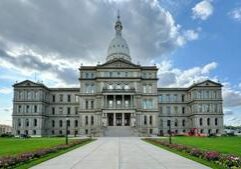
In 2023, Gov. Gretchen Whitmer and Democratic lawmakers passed a series of public acts requiring utilities to generate 80% of electricity from clean sources by 2035 and 100% by 2040. Public Act 233 gave the Michigan Public Service Commission authority to site large renewable energy projects, effectively bypassing township zoning and ordinances if regulators deem local rules too restrictive.
Proponents say the centralized approach is necessary to meet Michigan’s clean energy targets. Critics argue it undermines local governance and property rights.
Foster Swift Collins & Smith, P.C., representing more than 70 municipalities, filed an appeal in 2024 arguing that the order “overrides local ordinances and zoning regulations” and attempts “to centralize power at the state level, disregarding the preferences and concerns of local communities.”
“Local governments have a longstanding responsibility to ensure that developments align with their unique priorities, and this decision threatens to leave them powerless in the face of large-scale renewable energy projects,” said Michael Homier, chair of the firm’s municipal practice group.
The appeal seeks to restore local authority over renewable energy siting decisions.
Legislative Attempts to Restore Local Control
Since the legislation first passed in 2023, Republican lawmakers have been working to pass their own bills to give communities more say over solar and wind projects.
State Rep. Greg Alexander, R-Huron, introduced House Bills 4027-28 in January 2025 to “re-empower communities and residents with how key zoning decisions come together.”
“I think there’s a place for solar in Michigan, not necessarily industrial-scale solar,” Alexander told The Center Square. “I’m not usually in favor of the large-scale solar properties that are eating up our cropland.”
He noted the negative effects of industrial projects on rural areas, which was first seen in Michigan during the expansion of wind turbines.
“It has literally destroyed the communities,” Alexander said. “It has pitted neighbor against neighbor. It has turned long time friends and neighbors against each other.”
Senate Republican Leader Aric Nesbitt, R-Portage and a gubernatorial candidate, also unveiled a six-bill package last year meant to restore local energy control and roll back what he has labeled Michigan’s “green new scam.”
“This is about protecting our rural communities and our rural way of life,” Nesbitt told The Center Square. “Michigan already has energy rates among the highest in the Midwest. We already know extreme, overly-limiting energy policies in places like California and Europe have made energy more expensive and less reliable . . . Michigan cannot afford to follow in these footsteps.”
Alexander’s bills passed the Republican-controlled House but have stalled in the Democrat-led Senate. Nesbitt’s bill package never made it out of Senate committee.
Democrats Push Solar
House Democratic Leader Ranjeev Puri, D-Canton, highlighted the other side of the conversation. A proponent of Public Act 233, he highlighted the economic and environmental advantages of renewable energy.
“Solar energy is an important piece to our clean energy future. We’re seeing more and more energy companies in Michigan and even around the country transitioning and expanding their renewable energy portfolios,” Puri told The Center Square. “I don’t think they’re doing it just because . . . it’s the right thing to do, or even because of these mandates. I think it’s because it has shown to be an economically viable option that is going to help them improve their bottom line.”
Puri added that the move to state oversight can also benefit local communities, especially when the MPSC overrides their opposition.
“These projects are often complex, and sometimes local governments don’t have the infrastructure to fully evaluate their scope,” he said. “If a developer goes through the state process instead, they are required to provide millions of dollars in community benefits, which can fund things like libraries, parks and other local infrastructure.”
Nick Dodge, of the Michigan League of Conservation Voters, noted some of the reasons the league supports the growth of solar across the state.
“We need to be investing in the cheapest forms of energy,” Dodge told The Center Square. “Costs for solar have come down drastically in recent years and it is more affordable than ever. Increasing the buildout of solar energy will help rein in rising electricity costs.”
Andrew Linhares of the Solar Energy Industries Association added that solar could be a way to address Michigan residents’ ever-growing energy bills.
“Electricity prices in Michigan are rising faster than inflation. The fastest, lowest cost way to add power and bring down bills is to build more solar and energy storage,” he also told The Center Square.
Townships Fight Back
While the lawsuit against the MPSC is pending, some communities are taking action to try to work within the state’s current system and protect their control as much as possible.
State Rep. Jennifer Wortz, R-Quincy, is advising townships on adopting a Compatible Renewable Energy Ordinance.
“The key is to have a CREO in place,” Wortz said. “I’ve been trying to communicate to townships that they need to have a CREO in place. They need to set the guidance, because that is their one chance at having a say and maintaining some control here. You can’t ban it entirely, but you can set some guardrails.”
She added that the Foster Swift appeal, which House Republicans have also joined, will help further protect communities if the courts rule in its favor.
“That’s essentially what this lawsuit is contesting,” Wortz explains. “If a township has a CREO, then the Michigan Public Service Commission does not have the authority to override that.”
While Democrats so far have been largely supportive of these industrial-scale projects, Republicans said that is because those projects are primarily going to rural, Republican-represented districts.
Wortz said that could be changing though, especially as data centers and battery storage facilities move into urban areas across the state.
“If the data centers end up in places like Detroit, Flint, Benton Harbor, Saginaw, all those areas that are more liberal, then I think that’s going to create a pushback as well,” Wortz said. “I think it’s coming, I just don’t know exactly what is going to be the breaking point.”
Alexander joined Wortz in expressing doubt that any change will happen until there is a political change in the state legislature.
“With the Democrats controlling the Senate and Whitmer in office, you will see no change,” he said.
The Cost of Solar
David Stevenson, director of energy and environmental policy at the Mackinac Center, argued the push for solar in Michigan has been an artificial one funded by taxpayers.
“Solar energy has been pushed in Michigan for decades through mandates, tax incentives, and subsidies, yet it still provides only about 2% of the state’s electricity,” Stevenson told The Center Square. “In Michigan’s climate, solar is unreliable and delivers low returns. People should be free to use it if it works for them, but energy policy should be driven by reliability—not government mandates.”
Alexander seconded that concern, arguing that the state should be looking to other energy sources instead of solar.
“We need to look deeper at other possibilities, like nuclear. Solar makes tremendous sense in Nevada, but I’m a farmer – I wish I could see more sunlight,” he said. “If these things were financially prudent, they would have already been built by free enterprise without mandates or federal subsidies.”
Alexander also argued that not only are taxpayers footing the bill, but so are ratepayers.
“You don’t have to look very hard to recognize that your electric rates have increased by a lot lately, just even since Public Act 233 was introduced,” he said.
In Michigan, Consumers Energy and DTE Energy are the two major electric providers – providing electricity to a combined 4.1 million customers, or more than 80% of Michigan electric customers. In February, the MPSC approved a $242.4 million electric rate hike for DTE, while just today, Consumers Energy made its case before the MPSC for another $423 million electric rate hike.
Stevenson said this was to be expected.
“Large solar farms are an expensive way to generate little power in Michigan,” he said. “Limited sunlight and winter conditions mean low output per acre, forcing the conversion of farmland and costly investments in battery storage. Those costs are passed to ratepayers who are already facing higher electric bills.”
Wortz also warned that the push for 100% clean energy by 2040 will have real implications on Michigan’s power grid. She cited northern Michigan’s cold spells as an example.
“You cannot generate enough power from solar or wind in critical times like when you’ve got sub-zero temperatures and people have to run their furnaces more,” she said. “If coal plants were to close, we would be in an energy crisis and facing rolling blackouts.”
Looking Forward
Michigan’s renewable energy debate reflects a national conversation about balancing ambitious clean energy goals with local control.
Currently, Clean Grid Alliance reports 64 solar energy projects across Michigan, though that number is expected to grow quickly as energy companies work to align themselves with the state’s mandates.
For Republicans, the issue is just as much about energy as it is about local versus state control.
“Government is always best closest to home,” he said. “[It is] not acceptable through mandates from a faraway land.”
As the courts consider the municipalities’ concerns and legislators continue debating energy policy, Fayette Township resident Stephen Oleszkowicz said this issue is far from a theoretical one for his community and family.
Oleszkowicz highlighted the scale of the impact of an industrial-scale solar project on a community like his.
“When you look at a township the size of Fayette, we have roughly 13,000 acres in the township. There’s roughly 1,300 acres enrolled in the entire project on Heartwood One,” Oleszkowicz said. “Now, they are asking for another 13,150. That’s 20% of our township right there.”
He warned of the cascading effects of industrial-scale projects.
“It’s far beyond just a little localized thing. When they bring in solar like this, and they stabilize and enhance the grid to this effect, what surely follows is . . . battery storage . . . then data centers,” Oleszkowicz said. “It’s all a cascading effect.”
Recognizing the broader stakes, he urged residents to stay informed and engaged in local decision-making.
“Just get the word out there to as many people as you can,” he said. “It’s going on everywhere. We’re not the only ones. We’re not the first nor near the last.”
You can read the first installment of this series HERE, the second installment HERE, and the third installment HERE. Check back next week for an exclusive video to go along with this series.




Slight Chance Rain Showers then Mostly Cloudy
Latest News Stories
Clayton confirmation as new DNI delayed after Trump social media post

Federal $1.68B loan aims to lower Michigan energy costs, improve infrastructure

Illinois Quick Hits: Rockford to fill budget gap with reserve funds

Gas and fuel costs concern over 75% of voters, poll finds

Feds seek to join case to halt Evanston black ‘reparations’ payments

Mexican human smuggling rings busted nationwide
Trump-backed Moore leads Alabama Senate runoff
Hern projected to win Oklahoma GOP Senate primary
Pan criticizes Kiley as California congressional race heats up
U.S. Department of Justice investigates Newsom’s associates
G7 puts out statement on pursuing more private, ‘mutually beneficial’ international development
Advocates say price transparency alone won’t fix healthcare prices