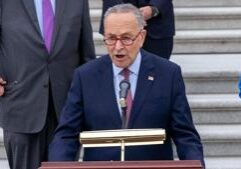
Schumer throws wrench into bipartisan plan to reopen DHS
The ongoing partial government shutdown is the second longest shutdown in American history as of Wednesday, and recent bipartisan negotiations are still far from complete.
In closed-door negotiations, pushed forward primarily by U.S. Sen. Katie Britt, R-Ala., a group of Senate Democrats and Republicans floated a tentative off-ramp: vote on the fiscal year 2026 Homeland Security bill, but withhold the $5.5 billion for Immigration and Customs Enforcement’s deportation operations.
The unfinalized compromise closely follows Democrats’ counterproposal to the fiscal year 2026 Homeland Security bill, which they have now tanked eight times. Their counterproposal – which Senate Republicans have tanked nine times – funds all agencies in the department except for ICE and Customs and Border Patrol.
Democrats have vowed they won’t support any Homeland Security bill that includes funding for immigration enforcement without significant reforms, including mandating agents obtain judicial warrants to enter private property and arrest migrants.
Republicans have granted some concessions but refused to accept all of Democrats’ demands, which they say would altogether handicap immigration enforcement.
By removing the most controversial parts of the original Homeland Security bill without promising specific reforms, Britt’s plan is an attempt to appease enough Senate Democrats to reopen DHS. Republicans, meanwhile, could potentially use a second budget reconciliation bill to push through the remaining ICE funding.
But multiple lawmakers on both sides and in both chambers are rejecting the proposal.
Many Republicans, including House Speaker Mike Johnson, R-La., think using budget reconciliation to fund ICE is too risky, though Sen. Lindsey Graham, R-S.C., announced Wednesday that a reconciliation bill is already in the works.
“The number one priority of the federal government has always been keeping our homeland safe and keeping our enemies at bay over there so they can’t hit us here,” Graham said in a statement. “The purpose of the second reconciliation bill is to make sure there is adequate funding to secure our homeland and to support our men and women in the military who are fighting so bravely.”
Yet Britt’s compromise route is now challenged by Democratic leaders as well, who had previously remained silent on the compromise plan when news broke Tuesday.
According to Wednesday comments by Senate Majority Leader John Thune, R-S.D., Senate Minority Leader Chuck Schumer, D-N.Y., has rejected Republicans’ latest offer. Schumer’s position is that either Republicans accept every one of Democrats’ demands, or DHS remains shut down.
“Democrats have repeatedly said that they want to pay TSA, Coast Guard, FEMA, and employees who defend America from cyberattacks. This bill would do it,” a frustrated Thune said Wednesday. “I hope Democrats will work with us to finalize an agreement and reopen the Department of Homeland Security this week.”






Slight Chance Showers And Thunderstorms
Latest News Stories

Illinois Quick Hits: Illinois gains population for third straight year

Chicago mayor calls for local government ‘process’ to prosecute feds

U.S. population growth slows after Trump border policies enacted

Maryland joins mid-decade redistricting fight
Democrats call for Noem’s removal after second fatal shooting by DHS agent

Illinois cannabis industry cautious on child-safety bill, questions focus on regulated products

87 indicted in TdA, Colombian, Venezuelan ATM jackpotting scheme in Nebraska

States, caregivers can now view key metrics for state child welfare systems

More Illinois Catholic schools close; candidates call for change
U.S. effort to limit China’s influence reaches Latin America

Govt. shutdown risk spikes as Senate Democrats vow to tank funding package

Report: EU regulations cost billions for American tech companies