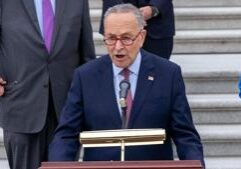
Schumer throws wrench into bipartisan plan to reopen DHS
The ongoing partial government shutdown is the second longest shutdown in American history as of Wednesday, and recent bipartisan negotiations are still far from complete.
In closed-door negotiations, pushed forward primarily by U.S. Sen. Katie Britt, R-Ala., a group of Senate Democrats and Republicans floated a tentative off-ramp: vote on the fiscal year 2026 Homeland Security bill, but withhold the $5.5 billion for Immigration and Customs Enforcement’s deportation operations.
The unfinalized compromise closely follows Democrats’ counterproposal to the fiscal year 2026 Homeland Security bill, which they have now tanked eight times. Their counterproposal – which Senate Republicans have tanked nine times – funds all agencies in the department except for ICE and Customs and Border Patrol.
Democrats have vowed they won’t support any Homeland Security bill that includes funding for immigration enforcement without significant reforms, including mandating agents obtain judicial warrants to enter private property and arrest migrants.
Republicans have granted some concessions but refused to accept all of Democrats’ demands, which they say would altogether handicap immigration enforcement.
By removing the most controversial parts of the original Homeland Security bill without promising specific reforms, Britt’s plan is an attempt to appease enough Senate Democrats to reopen DHS. Republicans, meanwhile, could potentially use a second budget reconciliation bill to push through the remaining ICE funding.
But multiple lawmakers on both sides and in both chambers are rejecting the proposal.
Many Republicans, including House Speaker Mike Johnson, R-La., think using budget reconciliation to fund ICE is too risky, though Sen. Lindsey Graham, R-S.C., announced Wednesday that a reconciliation bill is already in the works.
“The number one priority of the federal government has always been keeping our homeland safe and keeping our enemies at bay over there so they can’t hit us here,” Graham said in a statement. “The purpose of the second reconciliation bill is to make sure there is adequate funding to secure our homeland and to support our men and women in the military who are fighting so bravely.”
Yet Britt’s compromise route is now challenged by Democratic leaders as well, who had previously remained silent on the compromise plan when news broke Tuesday.
According to Wednesday comments by Senate Majority Leader John Thune, R-S.D., Senate Minority Leader Chuck Schumer, D-N.Y., has rejected Republicans’ latest offer. Schumer’s position is that either Republicans accept every one of Democrats’ demands, or DHS remains shut down.
“Democrats have repeatedly said that they want to pay TSA, Coast Guard, FEMA, and employees who defend America from cyberattacks. This bill would do it,” a frustrated Thune said Wednesday. “I hope Democrats will work with us to finalize an agreement and reopen the Department of Homeland Security this week.”






Showers And Thunderstorms Likely
Latest News Stories
Six Texas Republicans leaving Congress, finishing out term next year

WATCH: Johnson responds to Trump; Migrant rental assistance urged; Credit card oversight

Illinois quick hits: Cyber Monday security tips; expecting mother discharge legislation

First Look at Lincoln-Way 210’s Proposed 2026-2027 School Calendar

Everyday Economics: A consumer slowdown, fraying margins, and a big test for the Fed

Green Garden Township Buried Under 12.5 Inches of Snow; Sub-Zero Cold Snap Approaching Friday

Watchdog: Donations to liberal causes will continue despite Arabella’s rebrand

All Peotone Schools Earn ‘Commendable’ Rating on State Report Card

Frankfort Turns to County for Wildlife & Dangerous Animal Control

Illinois rejects federal ‘no tax on tips’ rule, keeps state tax on tipped income

JJC Foundation Director Kristin Mulvey to Retire After 25 Years of Transformative Leadership

Attack foiled in Ft. Worth day before National Guard troops shot in WDC