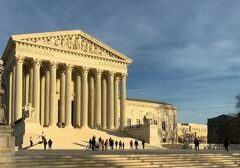
‘Conversion therapy’ bans in IL, other states, in danger, after SCOTUS ruling
The days appear to be numbered for a Colorado state law banning so-called “conversion therapy,” after the U.S. Supreme Court lopsidedly sided with a licensed counselor on the question of how to evaluate her claims that her constitutional free speech rights were violated by the law’s prohibition on discussing same-sex attraction and transgender identity with minors, unless she encourages and affirms those identities.
And the ruling likely tees up similar challenges and potentially shortened lifespans for similar bans in place in other states, including Illinois, observers say.
On March 31, the U.S. Supreme Court ruled 8-1 that lower courts were wrong to determine the state of Colorado had the constitutional authority to restrict the professional conversations of therapists, counselors and others licensed by the state to only the viewpoints the state deems to be in line with medical authority and consensus.
Specifically, the majority held the lower courts were wrong to apply a more lax legal standard, deferential to the state government, when evaluating the constitutional claims lodged by licensed professional counselor Kaley Chiles.
Chiles’ lawsuit took aim at the Colorado state law, on the books in the Mile High State, since 2019, which forbids “any practice or treatment … that attempts … to change an individual’s sexual orientation or gender identity.”
The law further prohibits counselors from any “effort to change behaviors or gender expressions or to eliminate or reduce sexual or romantic attraction or feelings toward individuals of the same sex.”
The high court noted, however, that the Colorado law only cuts one way. It “explicitly allows counselors to … provide ‘acceptance, support, and understanding for the facilitiation of an individual’s … identity exploration and development'” and to “provide ‘assistance to a person undergoing gender transition.'”
Essentially, the court says, the Colorado law prohibits counselors from helping clients explore moving away from an LGBT identity, but encourages counselors to actively assist clients in moving toward an LGBT identity.
And therein, the high court majority said, lies the law’s constitutional flaw.
In the ruling, authored by U.S. Supreme Court Justice Neil Gorsuch, the high court’s overwhelming majority agreed the law unconstitutionally regulates speech based on viewpoint.
“Colorado may regard its policy as essential to public health and safety,” Gorsuch wrote. “Certainly, censorious governments throughout history have believed the same.
“But the First Amendment stands as a shield against any effort to enforce orthodoxy in thought or speech in this country. It reflects instead a judgment that every American possesses an inalienable right to think and speak freely, and a faith in the free marketplace of ideas as the best means for discovering truth. However well-intentioned, any law that suppresses speech based on viewpoint represents an ‘egregious’ assault on both of those commitments.”
Gorsuch and the court’s five other conservatives were joined in the opinion by two of the court’s three liberal members, Justices Elena Kagan and Sonia Sotomayor, .
Only Biden-appointed Justice Ketanji Brown Jackson dissented.
“Colorado does not dispute that point (that its law chooses ideological sides,)” Kagan wrote in a concurring opinion. “Nor does it dispute that under normal First Amendment principles, that difference constitutes viewpoint discrimination.
“Indeed, the case is textbook. The law ‘distinguishes between two opposed sets of ideas’ —the one resisting, the other reflecting, the State’s own view of how to speak with minors about sexual orientation and gender identity.
“Or said just a bit differently, the law draws a line based on the speaker’s ‘opinion or perspective,’ and thus enables ‘speech on only one side’ — the State’s preferred side — of an ideologically charged issue,” Kagan wrote.
The Supreme Court’s ruling sends the case back to the lower courts for more proceedings, but this time, with instructions to apply so-called “strict scrutiny,” a more exacting legal standard that allows for very little restriction on individual speech rights.
Under that standard, the Colorado law almost certainly is doomed, legal observers agree.
But the decision likely will reverberate far beyond Colorado, likely spelling constitutional trouble ahead for similar bans in place in 24 other states, including Illinois.
Attorneys from the constitutional legal advocacy group, Alliance Defending Freedom (ADF), who represented Chiles in the case, asserted the ruling should put all state governments on notice.
“Kids deserve real help affirming that their bodies are not a mistake and that they are wonderfully made. The U.S. Supreme Court’s decision today is a significant win for free speech, common sense, and families desperate to help their children,” said ADF Chief Legal Counsel Jim Campbell in the statement. “States cannot silence voluntary conversations that help young people seeking to grow comfortable with their bodies.”
And in Illinois, attorney Jim Mauck, of the religious rights firm of Mauck & Baker, predicted it is only a matter of time before the Supreme Court’s ruling in the Colorado case spurs a similar legal challenge to Illinois’ similar state law.
“As I read the Colorado decision, I think Illinois’ law is effectively invalidated,” Mauck said.
Mauck already led a partially successful challenge to the state law.
Illinois lawmakers approved the state’s ban on such therapy in 2015.
Just as Colorado’s law, Illinois’ law similarly allows licensed therapists and counselors to only affirm and encourage LGBT identity. Any violation of the law by a licensed professional could result in disciplinary action against their license, potentially including revoking the license that allows them to professionally practice in the state.
After the state enacted the ban, Mauck represented a group of Christian pastors in a legal action to secure a court order specifically declaring the law could not be used by the state to prosecute clergy who espouse traditional Christian teachings on sexuality and gender.
However, the Illinois law to this point has not suffered a direct constitutional challenge similar to that brought by Chiles in Colorado.
Indeed, Illinois Attorney General Kwame Raoul was among a group of Democratic U.S. state attorneys general signing onto a brief before the U.S. Tenth Circuit Court of Appeals in 2024 supporting Colorado’s position that states have the constitutional authority to dictate what licensed counselors can say to their patients in the name of “treating the patient for the patient’s benefit” and “to protect the public.”
Mauck doubted Illinois or other states will rush to revise its law to bring the state’s regulatory structure into line with the Supreme Court’s opinion.
Indeed, in California, for instance, Democratic state lawmakers have instead indicated they will double down, pushing a new measure to allow “victims” to sue therapists and counselors for “malpractice,” should they “harm” patients by discussing sexuality or gender with minors in a way currently prohibited by the state’s potentially unconstitutional ban — essentially empowering trial lawyers to use lawsuits to regulate professional speech in a way desired by state officials when the First Amendment would prohibit the state from doing so directly.
It is unclear how Illinois may ultimately respond to the Supreme Court ruling. Democrats who dominate both states, however, routinely follow each other’s lead in proposing and enacting legislation, particularly on hot button cultural issues.
California, for instance, was the first U.S. state to ban such professional speech in a clinical setting in 2013. Illinois followed with its ban two years later, before nearly every other state to enact such bans.
Mauck, however, said the laws currently on the books in Illinois and other states and their associated regulatory enforcement regime likely won’t stand in their current form under the Supreme Court’s holding in the Colorado case.
Further, Mauck said, the Supreme Court ruling enabling therapists and counselors to speak more freely underscores the constantly changing medical and scientific consensus surrounding the hotly charged topics.
Mauck, for instance, noted the current consensus seems to be that gender and sexual identity is “fluid,” a finding he said undercuts the very basis of the state laws banning discussion and exploration of sexual and gender identity in young patients.
“I don’t expect the states will rush to change the laws, but I expect there will be more counselors who will be willing to challenge them,” Mauck said.





Chance Showers And Thunderstorms
Latest News Stories
Health Department Receives Budget Boost, Sunny Hill Admission Policy Updated

Meeting Briefs: Frankfort Square Park District for May 15, 2025

Board Meeting Shorts
Will County Board Meeting Briefs Package
Frankfort Park District Reorganizes Board, Explores Options for Tax-Impacting Projects

Aging Sara Park Building Poses Challenge for Park District
Meeting Briefs: Frankfort Park District Board for May 13, 2025

Township Board Unites Against State Consolidation Efforts
Planning Commission Outlines Three-Step Process for Land Use Plan
Road Projects Face Delays as Commissioner Reports Solar Leases on Needed Land
Green Garden Township News Briefs – March 2025

Peotone School Board Approves New Curriculum, Welcomes New Administrators