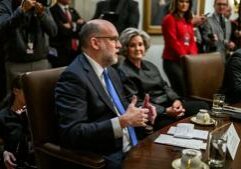
Vought testifies before lawmakers on Trump’s $2.1T budget request
Office of Management and Budget Director Russ Vought met with U.S. lawmakers Wednesday to discuss the president’s $2.1 trillion budget proposal for the next fiscal year.
However, rather than meaningfully engaging with the budget and discussing how to incorporate it into the upcoming fiscal year 2027 government funding bills, members of the House Budget Committee spent the hearing either defending or lambasting the Trump administration’s performance.
Instead of questioning Vought about the $1.5 trillion in defense funding requested – a more than 42% boost from last year – most Republicans praised the proposal, with Rep. Ron Estes, R-Kan., saying it “prioritizes cutting wasteful spending and rooting out fraud.”
The proposal slashes non-defense discretionary spending by $73 billion, which includes targeted cuts to WIC, the National Institutes of Health, the Low Income Home Energy Assistance Program (LIHEAP), climate research, homelessness assistance and maintenance funds for the International Space Station.
It also calls for completely eliminating the Job Corps, Food for Peace program, electric vehicle charger subsidies, and the Community Development Block Grant program, among other things.
Vought framed both the president’s request and the Trump administration’s performance in general as fiscally disciplined and making “historic progress on righting our fiscal ship.”
“Under President [Donald] Trump’s bold leadership, every tool in the executive fiscal toolbox has been used to achieve real savings, and our administration will continue to do so,” Vought told lawmakers. “A historic paradigm shift in the budget process is occurring and is producing real results for the American public. Fiscal futility is over.”
The U.S. government added $1.2 trillion to the national debt, which currently tops $39 trillion, over the last six months alone.
Not a single Democrat supported the budget proposal, opposing the program cuts and the defense funding boost.
The Pentagon has failed eight consecutive audits and remains the only federal agency to never pass an audit, which Rep. Glenn Grothman, R-Wis., also pointed out, despite supporting the president’s request as a whole.
Vought justified the defense funding request, arguing that it “will ensure the United States continues to maintain the world’s most powerful and capable military as we grapple with an increasingly dangerous world.”
The committee hearing is the first of many that U.S. lawmakers will hold this week and the next to begin preparing the 12 appropriations bills funding the federal government in fiscal year 2026, which begins Oct. 1.
Congress still hasn’t passed the last of this fiscal year’s appropriations bills, with the Homeland Security bill lying stagnant in the Senate as the DHS shutdown approaches the 60-day mark.




Mostly Sunny
Latest News Stories

Federal panel proposes new definition for sports betting
Illinois Venezuelans face economic ‘double whammy’

Ohio’s social media parental consent law allowed to go forward

HUD secretary discusses housing affordability during Michigan visit

Will County Land Bank Clears Committee With Two Amendments

Will County Committee Advances $179,000 Coroner Cot Purchase
Israel-Hezbollah agree to ceasefire, U.S. official says
Wisconsin senator wants to reinstitute race-based scholarships via zip code

Poll: Data center opposition more important than competition with China

Illinois Quick Hits: Fuel price drops below $4.25, still higher than in 2025
U.S.-Iran talks stalled after Israel-Hezbollah fighting

California’s billionaire tax officially heads to Nov. 3 ballot