Budget math undercuts Bessent’s deficit reduction pledge
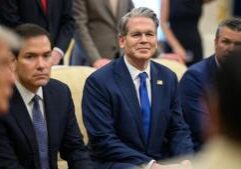
President Donald Trump’s next budget projects federal deficits running more than double Treasury Secretary Scott Bessent’s stated target through at least 2029 while also calling for a 42% increase in defense spending, a disconnect that drew questions Wednesday from Republican senators during a Senate Finance Committee hearing.
“We do not have a collections problem. We have a spending problem and we have a growth problem,” Bessent told the committee. “I believe that we can achieve something with a three in front of it by the end of President Trump’s term.”
The fiscal 2027 budget projects deficits above 5% of GDP through 2029 while requesting about $1.5 trillion in defense spending, roughly a 42% increase over fiscal 2026 enacted levels, according to the president’s budget request.
Sen. Bill Cassidy, R-La., pressed Bessent on Social Security, whose trust funds are projected to be depleted in 2033.
Bessent said the administration needed to get its “short-term house in order first” before addressing the program.
Cassidy pushed back.
“If we wait to get our short-term house in order, we will be three years away from insolvency,” he said.
Bessent said stronger economic growth would improve the program’s finances but did not outline specific policy changes to address the projected shortfall.
Sen. Thom Tillis, R-N.C., asked how the administration could reconcile a major increase in defense spending with its goal of reducing the deficit. Bessent said national security and economic security were linked but did not detail how the administration would offset the additional spending while pursuing deficit reduction.
Sen. Peter Welch, D-Vt., pressed Bessent on IRS staffing cuts, arguing that reducing enforcement capacity would widen the tax gap, the difference between taxes owed and taxes collected. The IRS projects the gross tax gap at $696 billion for tax year 2022.
Bessent disputed the notion that adding agents necessarily results in higher collections.
Bessent has publicly backed House Resolution 981, a nonbinding measure expressing the sense of the House that the federal deficit should be reduced to 3% of GDP by 2030. The resolution has remained in committee without action since its introduction in January.
The federal deficit is projected to reach nearly $2 trillion in fiscal year 2026, up from $1.7 trillion the previous year, according to the Congressional Budget Office. The federal government is projected to spend more than $1 trillion on interest payments in fiscal year 2026, according to the CBO – more than projected discretionary defense spending. Debt held by the public reached 100% of GDP in March, according to the Committee for a Responsible Federal Budget, and the Government Accountability Office warned in April that the nation’s fiscal path is “unsustainable.”
Maya MacGuineas, president of the Committee for a Responsible Federal Budget, said in a May statement responding to Treasury borrowing estimates that the trajectory is alarming.
“$2 trillion deficits used to be unheard of, and then they only occurred during major recessions,” she said. “It’s beyond scary that $2 trillion deficits are now the norm.”
The last time the federal deficit fell below 3% of GDP was 2015, and the federal government has not recorded a budget surplus since 2001.





Sunny
Latest News Stories

Meeting Summary and Briefs: Will County Board Finance Committee for June 2, 2026

Will County Coroner Reports Nearly 8,000 Death Investigations in 2025
Lawmaker says Pritzker reacted too quickly to Grant Park cross burning
Sanders bill would give U.S. stake in AI companies; analyst calls idea ‘nutty’

Poll: Most Americans don’t trust AI for news
Poll: 6 in 10 voters say country headed in wrong direction

Will County Committee Advances Three New Assistant State’s Attorneys
Will County Committee Advances $75,000 for U of I Extension
Trump shares look at Qatari aircraft for AF1

Feds plan for student loan interest rates could cost taxpayers
Altadena residents upset about multiple homes on lots

WATCH: GOP lawmaker voices opposition to gas tax increase