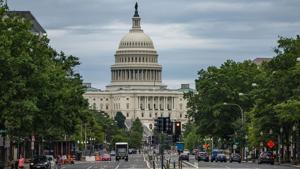
State officials prepared to drop Housing First grant criteria before HUD notice
Washington state officials were already removing Housing First grant criteria weeks before the U.S. Department of Housing and Urban Development released new rules that deprioritize the model after defining the federal homelessness response for years, records obtained by The Center Square show.
HUD issued a $4 billion opportunity on June 1 that shifted federal funding guidelines for homelessness services from focusing on the Housing First model to treatment, recovery and achieving self-sufficiency.
The funding notice follows another last fall that the courts blocked because it came mid-grant cycle.
For years, much of the money HUD spent on mitigating homelessness went toward renewing the same permanent housing projects, as taxpayer spending increased and more people ended up on the streets.
Now, HUD plans to fund service providers based on results, but not everyone is on board with this yet.
In a recent interview, Caitlyn McKenney, deputy assistant secretary for HUD’s Office of Special Needs, told The Center Square that homelessness increased about 27% nationwide from 2013 to 2025.
Meanwhile, taxpayer-funded beds increased by about 151%, and Continuum of Care spending increased by 111%.
The new federal funding notice and associated rules mainly affect grants through HUD’s CoC program.
“Housing first became housing only,” McKenney told The Center Square, arguing that moving forward, HUD will fund providers based directly on outcomes they deliver, rather than the amount of beds filled.
Housing First to Recovery First
Housing First centers on providing taxpayer-subsidized housing assistance without any precondition of sobriety or participation in treatment and other services.
The idea is that putting someone in a shelter or housing unit ends their homelessness and positions them to treat their addictions and other issues.
Critics say the approach creates a revolving door that sidesteps accountability at taxpayers’ expense.
“It’s spelled out clearly in the [funding notice]: invest in treatment and recovery, invest in your public safety response,” McKenney said. “Don’t continue with this idea that endless amounts of free, for life, no strings attached housing is going to solve the addiction crisis we see unfolding on Seattle’s streets.”
Washington state’s Department of Commerce has been anticipating the new funding rules for months.
Last month, the agency held a steering committee meeting for Commerce’s Balance of State Continuum of Care, which applies for federal funding for 34 counties.
King, Pierce, Snohomish, Spokane and Clark counties have independent CoCs that apply for federal homelessness grants for their respective areas.
According to the May 7 meeting notes obtained by The Center Square, Commerce has updated funding applications to include new eligibility requirements that eliminate Housing First criteria. The agency also rewrote various “equity narrative questions” to “reflect federal fair housing and nondiscrimination laws.”
The form now includes new content around transitional housing and supportive-services-only projects.
HUD’s new rules dropped the funding cap for Tier 1 projects, which have historically been permanent housing, from 90% to 60% of the total funding. That will force providers to compete as HUD incentivizes projects that require participation in treatment, case management and/or other supportive services.
“That’s the right policy, and yes, the social service organizations in the various counties will scream bloody murder, and they will blame Donald Trump, and they will do all these awful things — because you’re moving their cheese,” King County Councilmember Reagan Dunn told The Center Square.
“The proof’s in the pudding. Your policies aren’t working, and guess what? When that happens, we take money away, we put them into other things that actually matter, like drug and alcohol treatment, like mental health counseling, like job training,” Dunn told The Center Square in a recent interview.
Follow the money
HUD wants to focus on transitional housing and supportive-service-only projects moving forward. Still, permanent housing and other types of services will continue to receive federal funding to an extent.
Transitional housing is usually capped at two years and often requires people to engage in services to stabilize their lives. In contrast, permanent housing is a long-term, independent living situation.
Commerce told The Center Square that HUD’s new guidelines put all of the state’s CoC projects at risk.
However, state data shows that CoC funding at risk accounts for only a fraction of total spending.
“It is clear that the state will face a substantial loss of permanent housing funding,” Amelia Lamb, a media relations manager with Commerce, wrote in an email to The Center Square. “There will be a significant funding gap for permanent housing that state and local funding won’t be able to make up.”
An annual report that Commerce calls the “Golden” shows that Washington spent $966.6 million on homelessness projects statewide last year, serving about 338,000 people. However, only $80.64 million of that funding, or 8.3%, came from HUD’s CoC program.
Broken down further, about $71.7 million of the state’s CoC funding last year was spent on permanent housing-type projects, while just $2.19 million went to transitional housing.
Including other funding sources outside of the CoC program, Washington spent $377.4 million on permanent housing in 2025 and $32.5 million on transitional housing.
State lawmakers could shift their own funding strategy to fill any gaps left by HUD’s new guidelines, and Democrats in the Legislature already set aside $15 million earlier this year in anticipation of just that.
“With fewer housing options, we expect more people will stay unhoused for longer, and permanent housing exits from transitional housing programs will decrease,” Lamb wrote on behalf of Commerce.
What’s next?
Andrea Suarez, founder of We Heart Seattle, says Commerce should be pushing people from those services at risk of losing funding to HUD-aligned projects that prioritize achieving self-sufficiency.
Her organization has reported on permanent housing projects where individuals are given a tiny home-style unit to live in and then actively use fentanyl and other drugs with their neighbors in the project.
“King County Health Department hands out foil to cook illegal substances in your taxpayer-funded tiny house. Are you kidding me? ” Suarez told The Center Square. “You are subsidizing a person to live in a shack fit for a lawnmower to smoke drugs on foil the county hands them to use in illegal substances.”
She said Seattle and the rest of the state have hit rock bottom, and that there’s nowhere to go except up.
“This federal administration and [HUD] under [Secretary] Scott Turner is saving lives,” Suarez said.
The King County Regional Homeless Authority, which has been under fire following a recent audit that revealed millions in unaccounted funding, says the organization is adapting to HUD’s new grant rules.
“We’re in the early stages of the FY2026 NOFO and prefer not to speculate about the outcome. We’re working on putting forth a strong application,” KCRHA wrote in a statement to The Center Square.
The city of Spokane, which is responsible for submitting funding applications for the region’s CoC, issued a similar statement to The Center Square in response to HUD’s new funding notice and associated rules.
“It is too soon to predict the outcomes and impacts of this [funding notice] and its changes from prior [grant opportunities], as we must get through the local and national competitions before we know our funding levels and awarded project,” Spokane Communications Director Erin Hut wrote in a statement.
Hut says the new funding rules will impact HUD CoC contracts in Spokane beginning in August 2027.
According to records obtained by The Center Square, Family Promise of Spokane has been preparing since at least January and plans to “push towards results-based funding that is focused on housing outcomes, rather than realtor beds.”
“Long-term success in ending family homelessness requires changing the systems that finance and govern responses, not simply operating more efficiently within broken systems that reward things other than outcome results,” according to strategic directives that CEO Joe Ader sent to the organization’s Board of Directors in January.






Partly Sunny
Latest News Stories

Comptroller, Chicago officials debate tax fund sweeps

No public funds for new transit safety group
The future of American troops in Europe; Iran lead Rubio’s meeting with NATO

Tennessee congressman files articles of impeachment against Roberts

Illinois Quick Hits: Chicagoland chamber opposes ditigal ad tax

Board suspends Camp Mystic co-owner’s nursing license

Illinois bill banning ‘easily convertible’ handguns could pass this session

Deadline approaches for $1 million school choice award

Biometrics privacy law’s territorial reach limited, appeals court says
Watchdog says Biden Education Department defied court order on Title IX enforcement

Congress skips town without passing $72B immigration enforcement bill

EPA slashes regulations on refrigerants finalized during Biden-era