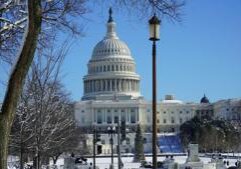
Senate pledges economic support for Russia-Ukraine deal as govt funding talks stall
As Republicans and Democrats remain deadlocked over how to fund the government for fiscal 2026 and prevent a shutdown, Senate leaders remain united on one front: Providing funding for Ukraine.
As President Donald Trump met with European leaders Monday – including Ukrainian President Volodymyr Zelenskyy – Senate Majority Leader John Thune, R-S.D., pledged his chamber’s willingness to provide economic assistance for Russia-Ukraine negotiations.
“President Trump should be commended for his dogged determination to bring peace to Ukraine and for his courage to engage with all parties in a way his predecessor refused to do,” Thune posted on X. “As peace talks continue today in Washington, the U.S. Senate stands ready to provide President Trump any economic leverage needed to keep Russia at the table to negotiate a just and lasting peace in Ukraine.”
While including a less flattering description of the president, Senate Minority Leader Chuck Schumer, D-N.Y., indicated his support for the beleaguered country as well, calling Russian President Vladimir Putin an “authoritarian thug” and urging Trump to “[stand] with Ukraine and our allies.”
Since Russia invaded Ukraine on Feb. 24, 2022, Congress has passed five major bills that cumulatively allocated over $128 billion to the Ukrainian government, including roughly $70 billion in military support. While no U.S. lawmaker has openly sided with Russia, some fiscal conservatives have objected to the high amount.
Thune’s offer to provide “economic leverage” comes as Congress nears the Sept. 30 government funding deadline without a clear bipartisan strategy in place. If lawmakers do not pass all 12 annual appropriations bills providing money for federal agencies through both chambers of Congress, they risk a government shutdown.
So far, only two of those bills have passed the House, while a three-bill minibus is the only 2026 appropriations legislation that has passed the Senate. Any appropriations bills passed in one chamber must be approved by the other chamber.
Even though Republicans control both chambers, they need Democrats’ help to finish the process when lawmakers return from their August recess in September. But Schumer has threatened to force a government shutdown unless Republicans “work across the aisle with Democrats to responsibly fund the government,” meaning that they must refuse to include any of Trump’s proposed budget cuts.
Given that lawmakers will only have a few weeks to synchronize and pass the rest of the fiscal year 2026 government funding bills, they most likely will pass a short-term Continuing Resolution.
A CR would keep government funding on cruise control until all appropriations bills are finalized. If the minibus (or other appropriations bills) pass both chambers by the Sept. 30 deadline, the CR would apply to the remaining federal agencies.
If lawmakers opt for the stopgap, Congress will have punted on funding the government properly for the fourth time in a row. Lawmakers never passed a fiscal year 2025 budget, instead passing three consecutive CRs to keep government funding on cruise control until Sept. 30.
Latest News Stories

Safety Surveys Reveal Over $570,000 in Needed Repairs at Peotone Schools

Will County Sees 50% Drop in Opioid Deaths, But Alarming Rise in Suicides

Will County Board Backs Effort to Rename ‘Stigmatizing’ Chicago Sanitary and Ship Canal

Access Will County Dial-a-Ride on Track for Full County-Wide Service in 2026

Arizona congressman calls for end to government shutdown

WATCH: Pritzker continues encouraging ICE protests after Guard blocked

Illinois quick hits: Ag incentives announced; Cook County announces increased budget
Senator urges Rubio to move forward designating Antifa a foreign terror organization

Divided Will County Board Authorizes Condemnation for 143rd Street Widening

Former board member expressed concerns about indicted DeKalb superintendent

Trump administration begins axing positions of furloughed federal workers
Fiscal Fallout: Illinois has among highest-paid state employees