
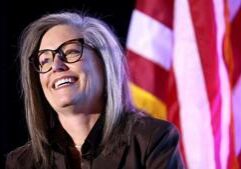
Experts dispute Arizona governor’s claims about state-funded school choice program
Arizona education experts are pushing back on claims Gov. Katie Hobbs made about the Empowerment Scholarship Account program during her State of the State this week.
Hobbs claimed the state-funded school choice program operates unchecked in Arizona and squanders taxpayer money.
“It seems like every day, we learn about new shopping sprees happening at the expense of taxpayers … Diamond jewelry, high-end clothing and furniture … Who knows what taxpayers will be footing the bill for tomorrow?” the Democratic governor asked during her speech on Monday before a joint session of the Republican-controlled Legislature.
She also said the ESA program’s “most ardent supporters must agree: It’s time we tackle the waste, fraud, and abuse to ensure taxpayer dollars are going towards true educational purposes.”
According to Matt Beienburg, the Goldwater Institute’s director of education policy, many of the claims made by Hobbs in her State of the State address “don’t hold up under scrutiny.”
Arizona’s ESA program requires parents to “document every single purchase they make,” he said.
“ Every item and every penny spent has to be reported to the state of Arizona. That is maximum transparency,” Beienburg told The Center Square.
Katie Ratlief, the Common Sense Institute Arizona’s executive director, said if people in the ESA program make a purchase “not permissible under law,” their “account is immediately frozen.”
She also said people who make unauthorized purchases with their ESA funds have to repay them.
The same level of transparency in the ESA program does not apply to public schools, Ratlief told The Center Square.
Beinburg agreed with Ratlief. “It’s pretty clear that despite the talking points against the ESA program, if there’s actually concern about transparency, the focus should be upon our state-operated government schools, who in many cases are failing to disclose both finances and curriculum.”
For example, Beinburg brought up an incident in which state Rep. Matt Gress, R-Phoenix, attempted to obtain financial transaction data for Telleson Union High School last year. However, the school told the representative that it would cost over $26,000 in fees to fill his request.
Arizona Superintendent of Public Instruction Tom Horne said under his leadership, the state Department of Education “has done a full-court press against waste and fraud.”
“I hired both a program auditor and an investigator, which had not been done before. I require that every expenditure be for a valid educational purpose and have been attacked for doing that,” Horne said in a statement to The Center Square.
“The governor needs to pay more attention to what is going on. She gets an ‘F,’” he added.
Regarding Hobbs’ claim the ESA program is squandering taxpayer money, “the vast majority” of Arizona’s K-12 spending goes to public and charter schools, Ratlief noted.
CSI Arizona said the ESA program for fiscal year 2026 costs $1 billion, while K-12 public school costs $7.1 billion, and charter school costs $2.1 billion. This means that public school funding accounts for nearly 70% of the state’s K-12 spending in fiscal year 2026.
Ratlief said around half of that money goes to students with special needs who have qualified for ESAs since 2011.
Beienburg noted Arizona public school funding has increased by $2.5 billion since 2022, when the ESA program opened to all students.
”Even adjusting for inflation on a per student basis. Arizona public school students are getting over $500 more a year today than they were prior to the expansion,” he stated.
In 2022, the state added $600 million in discretionary funding to its public schools, Beienburg explained.
“ That increase in public school funding in 2022 alone was larger than the entire net change in award amounts for the ESA program since the expansion. The net change in education dollars resulting from the ESA expansion is less than one year’s increase in the public school system that state lawmakers gave,” he noted.
The governor recycled many “false talking points” from “teachers unions and radical activist organizations that oppose parental choice and students having the opportunity to pursue the best education possible if that happens to fall outside of an institution they control,” Beienburg said.
Since 2012, Arizona public school enrollment has gone down, Ratlief stated.
The reason Arizona public schools are closing is that school districts kept constructing new buildings while keeping buildings open “that weren’t operating at a capacity that was sustainable,” Ratlief explained.
She said Arizona school districts are realizing they need to close schools because “demographics have fundamentally changed.”
Looking at the data, public schools are facing “enrollment pressures,” but the main drivers are “competition amongst public schools and the drop in birth rates,” Beienburg stated.
Since 2017, an estimated 40,000 students have left public schools to enter the state’s ESA program, Beienburg noted.
Furthermore, he stated Arizona birth rates have fallen by 36% since 2007. He estimated the state is having 10,000 to 20,000 fewer kids yearly being born in Arizona than it did 19 years ago.
According to Beienburg, this means that there are around 200,000 fewer kids in Arizona who need to be educated.
“ We just don’t have as many school-aged kids in Arizona as we used to. Things have changed fundamentally,” Ratlief noted.
Looking ahead, Ratlief said she encouraged lawmakers to view the ESA program through a “forward-focused lens.”
“Parents are used to choice in Arizona now. They want access to open enrollment, charter schools, ESAs, homeschooling, micro schools, all this,” she stated.
Ratlief noted Arizona needs to ask how it can “continue to improve things for parents and taxpayers in an environment they’ve come to expect,” rather than figuring out how to go backward.




Chance Showers And Thunderstorms
Latest News Stories
Committee Highlights ‘Lack of Teeth’ in County Code Enforcement Process
Meeting Briefs: Will County Ad-Hoc Ordinance Review Committee for July 22, 2025
Peotone School Board Approves Sweeping Personnel Changes, Fills Key Vacancies
Resident Alleges Financial Mismanagement, Underused Buildings at Peotone Board Meeting
Meeting Briefs: Peotone School District 207-U for July 21, 2025
Crete Township Wins Approval for New Digital Sign at Community Center
Will County Planners OK Oversized Garage Near Naperville, Overriding Staff Recommendation
Green Garden Landscaping Business Gains Permit Amid Strong Neighbor Support
Meeting Briefs: Will County Planning and Zoning Commission for July 15, 2025
Frankfort Approves ‘Whisk & Flame’ Culinary Studio, Slashes Parking Requirement for Downtown Property
Frankfort Village Board Adopts $59.4 Million Appropriation for Fiscal Year 2026
Frankfort Establishes New Zoning Rules to Attract Data Centers