Peotone 207U Reviews Long-Range Facilities Options; Costs Range from $63M to $142M
By Andrea Arens
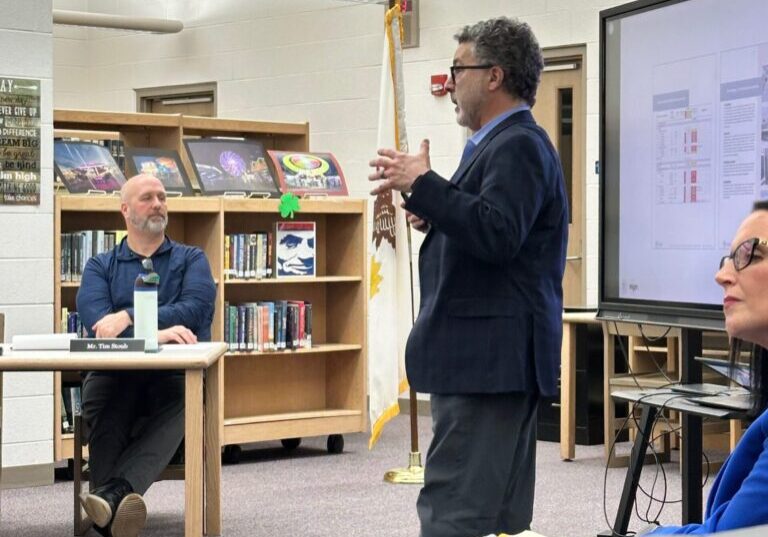
The Peotone Community Unit School District 207U Board of Education received a comprehensive feasibility study presentation Wednesday, Feb. 18, from architecture and engineering firm Wight & Company, outlining long-range facility options that could cost between $63 million and $142 million, depending on the path chosen.
The months-long study examined building conditions, educational alignment, enrollment capacity, community input and financial impacts. The result is a roadmap — not a final decision — but one that lays out significant choices for the district’s future.
Assessing Current Conditions
Wight & Co. conducted a full facilities condition assessment of each building, evaluating structural systems, roofs, HVAC, mechanical systems and overall infrastructure. Each system was rated and assigned a projected remaining useful life, along with estimated replacement costs.
A key benchmark used in the study was the Facility Condition Index (FCI), which compares the cost of repairs to the cost of replacing a building entirely. When repair costs exceed roughly 30 percent of replacement value, it raises concerns about long-term viability.
Peotone Intermediate Center at 40% and Conor Shaw Center at 25% were identified as being in the poorest condition among district facilities. Peotone Elementary (15%), the junior high (19%), and the high school (8%) were found to have more remaining useful life but still require substantial investment.
To simply maintain current facilities and address infrastructure needs over the next decade — without major reconfiguration — the district would need an estimated $63.4 million. That “baseline” scenario keeps all existing buildings in operation, including Peotone Intermediate Center.
Renovation and Reconfiguration Scenarios
Wight & Co. also developed two renovation-based scenarios that would reconfigure grade levels and divest from the PIC facility:
- Scenario A: PreK–5 elementary and 6–8 junior high model — approximately $70.6 million
- Scenario B: PreK–4 primary and 5–8 middle school model — approximately $74.3 million
Both options require additions at Peotone Elementary and renovations at the junior high to accommodate shifting grade levels. Improvements would include site reconfiguration, expanded classroom space, storm shelter construction triggered by new additions, upgraded commons areas and modernization of learning environments.
Community engagement sessions indicated strong support for responsible financial stewardship and investing in buildings already owned by the district. Participants emphasized data-driven decision-making and preserving community-centered schools.
New Construction Options
The most expensive options presented involve full new-construction schools.
Wight & Co. outlined two primary new-building approaches:
- Consolidated new PK-8 school with renovations at PHS(Option 1): Approximately $142.6 million
- A second new construction model with new PK-5 building and renovations at both PJHS and PHS (Option 2): Approximately $96.3 million
- A third new building new construction model with new 3-8 building and renovations at PES and PHS: $107 million
The $142.6 million option would construct a fully consolidated new school facility, offering what architects described as the greatest long-term flexibility, educational efficiency and modern design benefits. However, officials acknowledged that building entirely new facilities significantly increases costs due to site development, permitting, infrastructure and construction requirements.
The $96.3 million new PK-5 building scenario includes new construction while incorporating renovation elements. Under that plan, some facilities — such as the district office — could be incorporated into new construction rather than requiring separate upgrades.
The $107 million new 3-8 building scenario also incorporates renovations at PES and PHS and places the district office at the new construction.
Board members clarified during the meeting that the new construction figures account for divesting from buildings like Conor Shaw and eliminating the need to renovate certain existing facilities.
“These are the most expensive options because you are building a building,” Stuart Brodsky of Wight & Co. explained. “There are more costs involved when you move to new construction.”
Enrollment and Capacity Considerations
The study also examined projected enrollment over several years and established “planning enrollment” targets slightly above current numbers to provide a buffer.
For example, one scenario projected PreK–5 enrollment at 541 students but used a planning target of 570 students to avoid building over capacity.
Officials noted that expansion opportunities at Peotone Elementary would be tight due to site constraints, though designs could allow for future second-story additions if needed.
Board members asked whether the buildings accounted for growth based on projections. Wight representatives responded that planning figures were developed collaboratively with district leadership and reflect cautious, moderate growth assumptions rather than aggressive expansion.
Timeline: A Multi-Year Process
Board members also pressed for clarity on how long any of these options would take.
Wight representatives outlined a typical timeline:
- Design phase: 9–12 months (concept refinement, schematic design, construction documents)
- Bidding and permitting: Several additional months depending on market timing
- Construction: 14–16 months for new buildings
In total, a new construction project could take approximately 2.5 years from formal direction to completion.
Renovation projects can sometimes move faster but often face complications due to working around occupied buildings and maintaining educational continuity.
“The quickest you can build a new building is typically 14 to 16 months after design,” the firm noted, adding that market conditions have stabilized somewhat after several volatile years of construction cost escalation.
Board members acknowledged that the feasibility study is not a final decision but the beginning of a long-term planning process.
“This isn’t the time to decide everything,” board member Tim Stoub said. “This is to sort of chart that next step and then there’s planning and there’s a bid process, and then there’s construction. So, this is a two to three year sort of process that we’ve begun.”
A Roadmap, Not a Final Answer
Wight & Co. emphasized that the feasibility study is intended to serve as a flexible roadmap for the district’s future. It provides data, cost comparisons and conceptual planning options that the board can refine over time.
Whether the district ultimately pursues baseline improvements, renovation-based grade reconfiguration, or full new construction will likely depend on further financial analysis, community engagement and potentially voter approval if bonding is required.
For now, the presentation makes one thing clear: maintaining and modernizing Peotone’s school facilities — in any form — will require significant investment. The question ahead is how the community wants to shape that investment for the next generation of students.




Showers And Thunderstorms Likely
Latest News Stories
Will County Animal Protection Services Seeks New Facility Amid “Gaping Wound” of Space Crisis
Board Confronts Animal Services Crowding, Explores Future Facility Options
Will County Board Members Demand Transparency in Cannabis Tax Fund Allocation
Homer Glenn Residents Push Back on 143rd Street Widening as Officials Signal “Tentative Agreement”
Will County Forges 2026 Federal Agenda Amid D.C. Policy Shifts, ‘Big Beautiful Bill’ Impacts
Health Department Seeks $1 Million Levy Increase to Prevent “Weakened System”
County Rolls Out New “OneMeeting” Software to Improve Public Access

Meeting Summary and Briefs: Will County Board Finance Committee for August 5, 2025
Will County PZC Approves Rezoning for Truck Repair Facility on Manhattan Road Amid Resident Concerns
Key Stretch of Bell Road on Track for Thanksgiving Reopening, Committee Approves Additional Funds
Will County Leglislative Committee Opposes Federal Push for Heavier, Longer Trucks
Will County Reports Progress in Opioid Fight, Highlights New FDA Labeling Rules